Requests arrived as messages
Material and maintenance requests came through chat groups with no ticket, no status and no record of who approved what.

An office system only works if the people on site actually use it. Drivers, technicians and employees needed the parts that concern them on a phone, in Arabic, without training — so we built the field half of the platform as its own app.
The situation
Everything that starts in the field — a trip, a breakdown, a receipt, a material request — was arriving as a message or a piece of paper, then being retyped by someone in the office days later.
Material and maintenance requests came through chat groups with no ticket, no status and no record of who approved what.
Employees paid out of pocket, kept paper receipts and waited for someone to enter them, which delayed both the claim and the cost landing on the project.
Trips were allocated by phone call, and completion was confirmed the same way, so utilisation could not be measured.
Leave balance, iqama expiry, bank details and payslips were all requests to a person rather than something an employee could check.
Built on the same API as the ERP, so what happens on site appears in the office immediately.
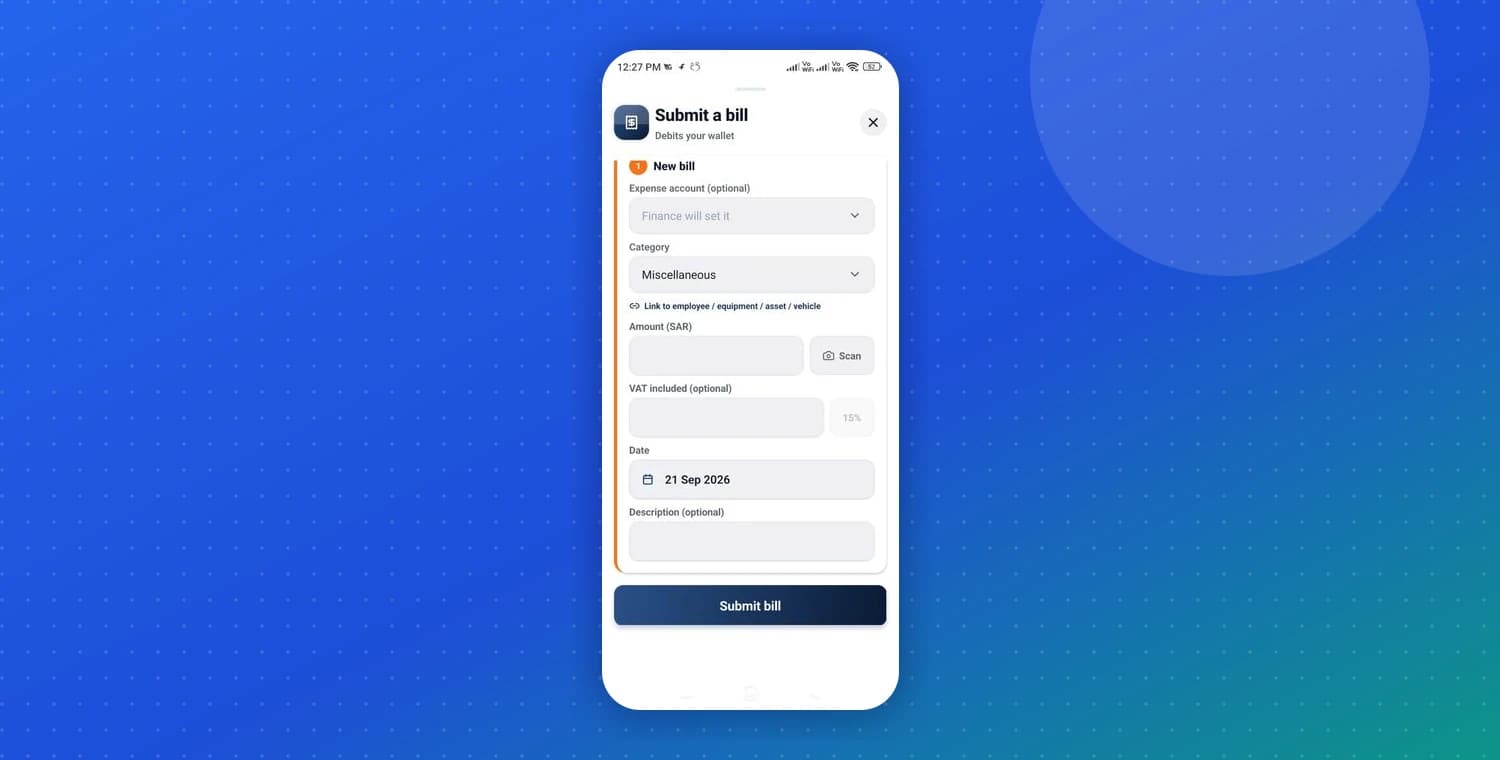
Photograph the receipt, and the amount, VAT and date are captured with it — linked to an employee, vehicle, asset or equipment, and routed to finance with the cost centre attached.
Assigned trips, status updates and completion recorded by the driver, feeding the fleet utilisation figures the office reports on.
Site teams raise requests against a project or machine, with approval routing and a status the requester can follow.
Leave balance and requests, iqama and document status, bank details and payslips — available to the employee instead of arriving as an HR question.
Crew and equipment mobilization steps recorded from the site, and an in-app support channel that creates a real ticket.
Approvals, assignments and status changes reach the phone, so work is not waiting on someone opening a laptop.
What changed
The app removed the re-typing step entirely. A receipt photographed on site becomes an expense line with VAT and a cost centre, and a request raised at a machine becomes a tracked ticket rather than a message.
Platforms from a single codebase
Re-entry between the field and the office
Arabic-first, for the people using it
A single codebase for both platforms, sharing the ERP's API and authentication.
Tell us which step gets retyped in the office. That is usually the first screen worth building.